
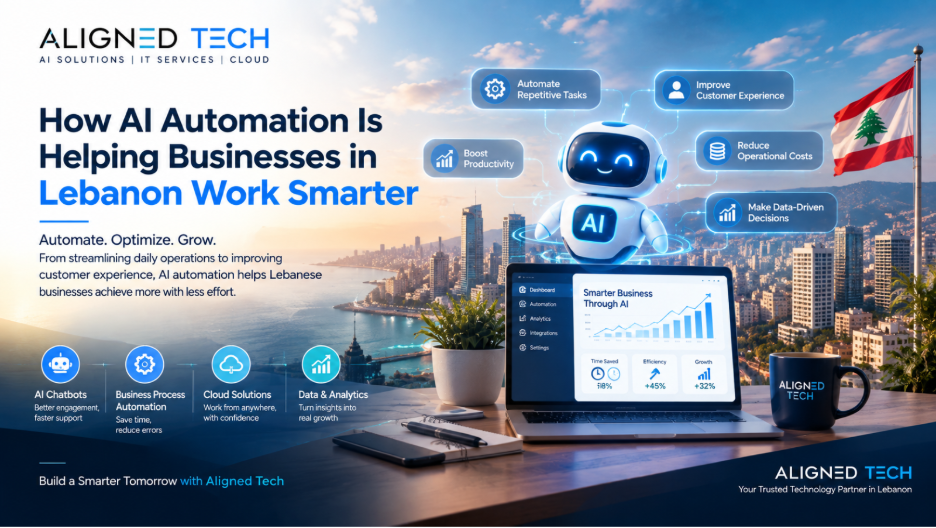
How AI Automation Is Helping Businesses in Lebanon Work Smarter
AI Automation
Introduction
Businesses in Lebanon are under constant pressure to improve productivity, control operating costs, and respond faster to customers. AI automation offers a practical way to address these challenges by combining artificial intelligence with business process automation. Rather than replacing every existing system, a well-designed automation strategy connects people, software, and data so routine work can move faster with fewer errors.
What AI Automation Means
AI automation combines technologies such as machine learning, natural language processing, intelligent assistants, workflow automation, and data analysis. Traditional automation follows fixed rules, while AI-powered automation can interpret text, classify requests, extract information, recognize patterns, and support decisions.
For a Lebanese business, this could mean automatically routing customer inquiries, extracting information from documents, creating support tickets, summarizing conversations, qualifying sales leads, or generating reports. The objective is not to automate everything. It is to identify repetitive activities where intelligent technology can create measurable value.
Where Lebanese Businesses Can Apply It
Customer service is one of the clearest opportunities. An AI assistant can answer frequently asked questions, guide customers to the appropriate service, collect basic information, and hand complex cases to an employee. This provides faster responses while allowing staff to focus on issues requiring human judgment.
Sales teams can use AI to capture leads from websites or messaging channels, ask qualification questions, categorize prospects, and notify the right salesperson. Back-office teams can automate document processing, data entry, notifications, approval workflows, reporting, and recurring administrative tasks.
Arabic and Multilingual Customer Experiences
Language is an important consideration for organizations serving Lebanon and the wider region. Customers may communicate in Arabic, English, French, or a mixture of languages. AI assistants can be designed to recognize different forms of customer communication and route conversations appropriately.
The best approach is not simply to add an Arabic translation layer. Businesses should consider how customers naturally ask questions, what terminology they use, and when a conversation should be transferred to a human.
Connecting Existing Systems
A successful AI project should fit into the company’s current technology environment. Many organizations already use CRM, ERP, accounting, helpdesk, productivity, or e-commerce platforms. AI automation can often work as an intelligent layer connecting existing applications.
For example, a chatbot can capture a customer request, retrieve approved information from a knowledge base, create a CRM record, and notify a team member when human intervention is needed. This connected workflow is more valuable than a chatbot that only answers questions.
Security and Human Oversight
AI automation should be introduced with appropriate security and governance. Businesses should decide what information the AI system can access, which users can access it, how data is stored, and which actions require human approval. Sensitive processes should have clear controls and auditability.
Human handoff is equally important. An AI assistant should recognize situations it cannot handle confidently and move the conversation to a person rather than inventing an answer.
How Aligned Tech Approaches AI Automation
Aligned Tech focuses on practical AI and automation solutions designed around business workflows. The starting point is understanding the organization’s objectives, customer journeys, repetitive tasks, systems, and operational constraints. From there, a roadmap can identify high-value opportunities and define the integrations and controls needed for implementation.
This approach allows a company to begin with a focused use case, measure the result, and expand gradually. The first project might be an AI customer assistant, workflow automation, document processing, reporting, or an integrated WhatsApp solution.
Conclusion
AI automation is becoming a practical business capability rather than a purely experimental technology. Lebanese organizations can use it to improve customer response times, reduce repetitive work, support sales teams, and connect information across existing systems. For organizations exploring AI automation services in Lebanon, the goal should be simple: make everyday operations smarter, faster, and more consistent while keeping people in control of important decisions.
About The Author